3D Orca Ocean Tumbler: A Strategic Asset for Custom Drinkware Projects
In the competitive landscape of custom drinkware, visual distinctiveness is often the primary driver of sales. The 3D Orca Ocean Tumbler design emerges as a compelling solution for creators and entrepreneurs seeking to elevate their product offerings without incurring significant upfront costs. This digital asset is specifically engineered for 20oz skinny tumblers, addressing a specific niche within the broader sublimation market. By providing high-resolution vector-ready graphics, it allows professionals to integrate complex marine imagery into their inventory with minimal friction.
The core value proposition of this resource lies in its technical precision and versatility. Unlike generic clip art that may pixelate or lose detail during resizing, this 3D Orca Ocean Tumbler file set is delivered at 300 DPI. This resolution standard ensures that when the design is transferred onto physical substrates via heat press or sublimation, the resulting image retains crisp edges and vibrant color gradients. For business owners managing production workflows, this reliability reduces waste and rework, directly impacting the bottom line.
Technical Specifications and File Architecture
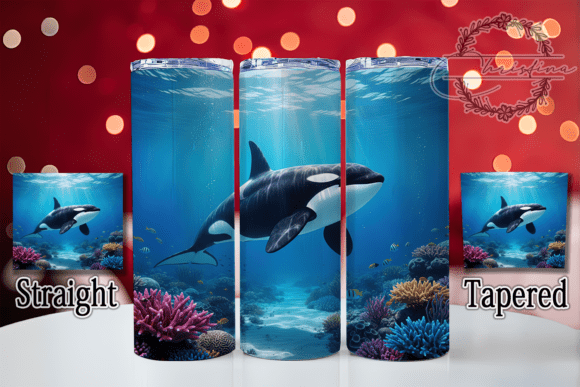
A critical component of evaluating any digital creative asset is understanding its delivery format and structural integrity. The 3D Orca Ocean Tumbler listing provides two distinct PNG files, each tailored to the unique geometry of modern drinkware. The inclusion of both a straight design and a tapered design is not merely a convenience; it is a necessity for achieving a professional finish on 20oz skinny tumblers.
- Straight Design: Optimized for the uniform cylindrical section of the tumbler, ensuring the orca's body appears proportionate and undistorted along the main viewing angle.
- Tapered Design: Specifically scaled to accommodate the narrowing base of the cup. This prevents the common issue where images appear squashed or stretched at the bottom of the vessel.
Both files are high-resolution, which is essential for maintaining print quality. When preparing artwork for sublimation, the source file must be large enough to withstand the scaling process required by various printer drivers and RIP software. The 300 DPI specification guarantees that the final output will look sharp, avoiding the "fuzzy" appearance that can damage a brand's reputation. This attention to technical detail suggests that the creator understands the practical demands of the printing industry.
Operational Flexibility Beyond Standard Tumblers
While the primary use case for the 3D Orca Ocean Tumbler is clearly defined as 20oz skinny tumblers, the utility of such assets extends further. The design's scalability allows it to be repurposed for a variety of creative projects. In a dynamic market, being able to pivot quickly is a significant advantage. A designer might find that the same striking orca graphic works effectively on laptop sleeves, phone cases, tote bags, or even wall art, provided the aspect ratio is adjusted correctly.
This flexibility supports small business owners who operate with lean inventories. Instead of commissioning multiple unique designs for different products, a single high-quality asset can serve as the centerpiece for an entire product line. However, users must exercise caution regarding aspect ratios. While the file is resizable, stretching a tapered design meant for a cylinder onto a flat surface requires manual adjustment to maintain the intended aesthetic balance. The "versatile use" claim holds true, but it requires a baseline of design literacy to execute properly.
Color Accuracy and Production Realities
One of the most persistent challenges in digital-to-physical manufacturing is color fidelity. The 3D Orca Ocean Tumbler disclaimer regarding screen resolution and monitor calibration reflects a realistic understanding of the production process. No matter how accurate the digital preview is, the final printed color will inevitably vary based on the specific ink, substrate material, and heat press settings used.
For professionals, this means that while the design provides an excellent starting point, color management remains a critical step in the workflow. It is advisable to perform test prints on scrap material before committing to a full production run. The deep blues and stark whites of an orca design require precise color balancing to avoid appearing muddy or washed out. The fact that the creator explicitly addresses this variance demonstrates transparency and builds trust, a key element of E-E-A-T (Experience, Expertise, Authoritativeness, and Trustworthiness) in content creation.
Users should also consider the limitations of their printing equipment. Sublimation printers typically have a limited color gamut compared to CMYK offset printing. While the 3D rendering of the orca is likely designed to pop on white tumblers, achieving the exact saturation seen on a high-end monitor may require post-processing adjustments in software like Photoshop or Illustrator. The design serves as a robust foundation, but the final result depends heavily on the operator's skill.
Ideal Use Cases and Target Audience
Who benefits most from acquiring the 3D Orca Ocean Tumbler? The answer points toward specific segments of the creative economy. Small business owners running Etsy shops or local print-on-demand services will find immediate value. These entrepreneurs often need high-quality graphics to differentiate their stores from competitors using low-resolution stock images. The professional quality of this design helps establish credibility and allows for premium pricing strategies.
Freelance designers and marketers also stand to gain. For those fulfilling orders for clients who want ocean-themed merchandise, this asset eliminates hours of searching for suitable royalty-free images or paying for expensive commissions. Educators teaching design courses could use this as a case study for discussing file preparation, resolution, and color theory. Even serious hobbyists looking to create personalized gifts for family members will appreciate the ease of use and the impressive visual impact of a 3D rendered animal on a sleek tumbler.
Strategic Considerations and Limitations
Despite its strengths, the 3D Orca Ocean Tumbler is not a universal solution. The design is static; it does not come with editable layers in a vector format like SVG or AI. This means that if a client requests a slight modification—such as changing the size of the whale's tail or adding a name—the user cannot easily edit the source file without raster-based editing tools. This limitation may frustrate power users accustomed to non-destructive editing workflows.
Furthermore, the reliance on a single file type (PNG) means that the background is transparent, which is convenient, but the lack of vector data limits infinite scalability. If a user attempts to blow up the image for a massive billboard, the pixels will eventually break down. Therefore, the design is best suited for medium-scale applications like drinkware, apparel, and accessories, rather than large-format signage.
Another consideration is market saturation. As with any popular theme, ocean life designs are common. To make the 3D Orca Ocean Tumbler truly effective, it must be part of a cohesive branding strategy. Simply slapping the image on a cup is rarely enough to drive sales in a crowded marketplace. Successful application involves pairing the design with complementary text, consistent color palettes, and high-quality packaging.
Conclusion on Value and Application
The 3D Orca Ocean Tumbler represents a pragmatic investment for anyone involved in the custom drinkware sector. Its strength lies in its adherence to technical standards—specifically the dual-file setup for tapered and straight surfaces and the high-resolution output. These features reduce the barrier to entry for creating professional-grade products. While it requires a degree of operational discipline regarding color management and file usage, the return on investment in terms of time saved and quality achieved is substantial.
For professionals, entrepreneurs, and creators looking to expand their product lines with visually striking, nature-inspired themes, this digital download offers a reliable and efficient path forward. It bridges the gap between amateur craftsmanship and commercial polish, making it a worthy addition to a well-curated library of design assets. Ultimately, its success depends not just on the file itself, but on how strategically the user integrates it into their broader business model.